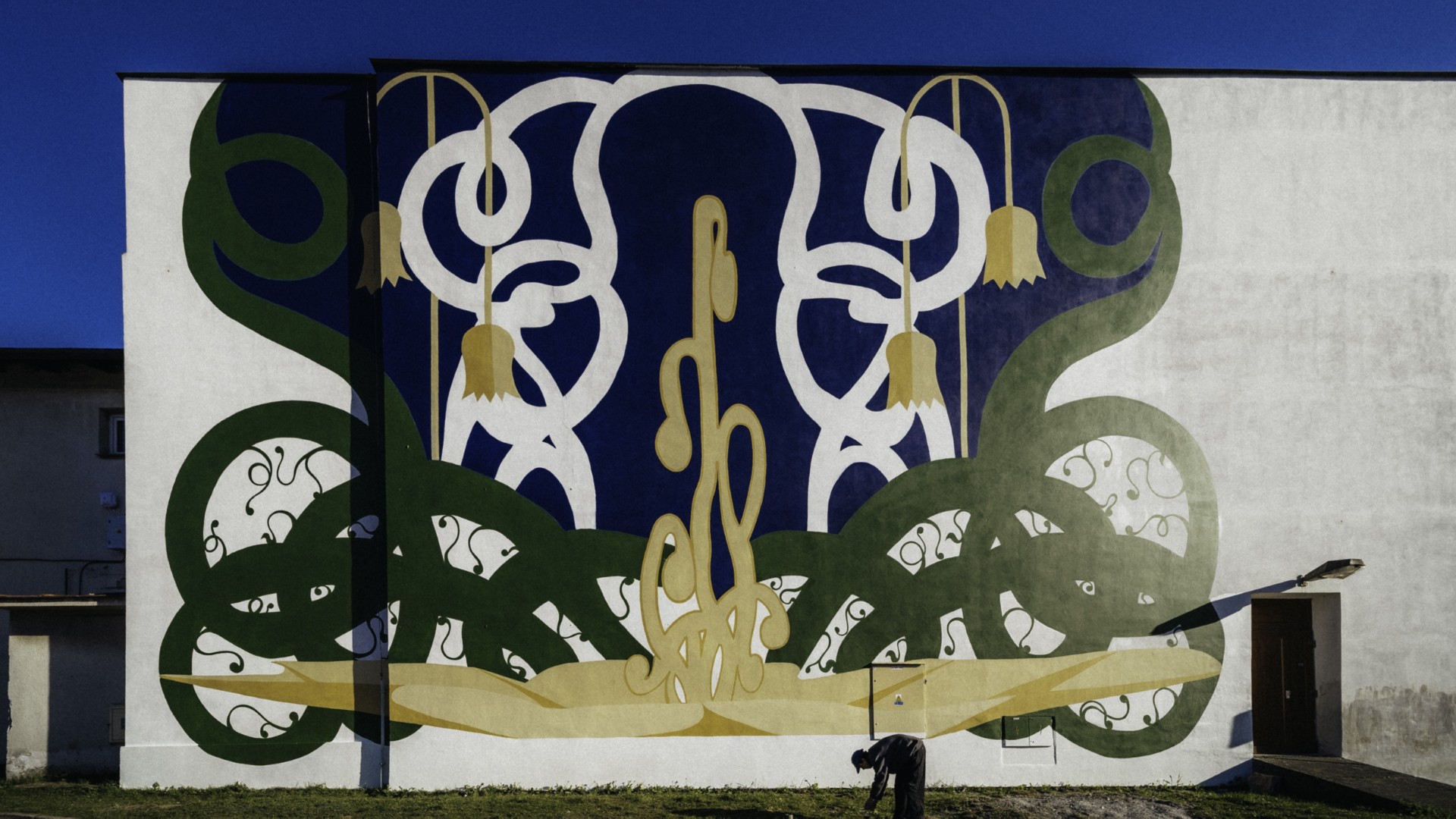
RICHARD MOŠTĚK
MURAL
Painting Studio 3
You decided to create your graduate work, which marks the completion of your studies in Brno, in the town of Jeseník. What does the mural in a public space symbolize, and what is your relationship to the place?
I chose Jeseník deliberately; it is my hometown, where I grew up. So, the location is close to my heart, and I know it well. I conceived the mural thematically and visually as site-specific – taking into account both the geographical location of Jeseník and the specific spot in the city where the mural is located. The mural itself explores the theme of water from various perspectives: from the local spa tradition of hydrotherapy, through its economic aspects, to the recurring floods in the region.
Was it difficult to arrange for your work to be produced in the city? Who did you have to deal with, and how did the whole process go? How long can the painting remain on the building’s facade?
Since the Petr Bezruč Theater building is managed by the city, I first contacted the director of MKZ Jeseník, Ms. Petra Fusová, who trusted me and the project and played a major role in successfully navigating it through the city authorities, who eventually authorized it. According to the city plans, the theater’s facade is scheduled for renovation as part of the Živel program in 2030 – so that is the provisional timeframe for the painting’s lifespan.
I read that the surface on which you created the painting had previously been used for advertising murals. Were you inspired by their aesthetic in any way, or did you want to completely transform the spirit of the place? Did you ever consider leaving some traces of the advertising layers beneath your painting?
The previous advertisement had a strong 1990s typographic aesthetic. One of the initial impulses for choosing the location was to transform the advertising space into a non-commercial one. The advertisement that caught my attention most was the sign “WELCOME TO JESENÍK,” which I could have imagined working with further, but I had doubts as to whether the general public would understand it.

photo: Polina Davydenko